
By Paula Companioni*
Translated by Eduardo Aguilar
In the geopolitical imagination of the Caribbean, Haiti is often portrayed as a territory with an almost mythical mining potential. From the U.S. occupation of 1915 to contemporary debates about economic development, the narrative of a “country sitting on a gold mine” has been recurrent. However, the current reality is far from this fiction.
While neighboring Dominican Republic has recently announced the discovery of rare earth deposits in Pedernales, Haiti faces an uncomfortable question: what actually lies beneath its soil? This article examines three key issues—what minerals exist, where they are located, and the real size of the reserves—before concluding with a reflection on how this uncertainty becomes a double-edged sword in today’s volatile geopolitical landscape.
Gold, Copper, and Bauxite: Resources Yet to Be Determined
Haiti’s geology, shaped by the collision of tectonic plates, has endowed the island with a varied subsoil. Geological studies point to the presence of gold, copper, and bauxite, as well as potential deposits of cobalt and, according to more recent speculation, rare earth elements.
Haitian sociologist Jean Eddy Saint Paul, in a recent interview, confirmed this perspective:
“Nowadays there is a big hype about minerals and rare earths. I believe that in Haiti we have both. It is a very important country in terms of mining and rare earth resources.”
However, the myth collides with a technical reality. Claude Prépetit, director of Haiti’s Bureau of Mines and Energy (BME), stated in February 2025 that the country has not invested in mining research since 1993 and that all metal exploration activities stopped in 2012. This means that although there is geological certainty about the presence of these minerals—samples and known veins exist—there is no updated data regarding their concentration, economic viability, or purity. Haiti lacks modern maps needed to turn geology into economic knowledge.
Where Are These Resources Located?
The location of these resources is not random and tends to concentrate in mountainous areas and along the geological fault lines that cross the country. Historically, the main exploration permits have been granted in the northern region, specifically in the Massif du Nord, where gold and copper veins have been identified.
One of the most sensitive areas today is the southern border, particularly the Belle-Anse and Anse-à-Pitre region in the Southeast department. Following the discovery of 114 rare earth deposits in Pedernales (on the Dominican side), geologists estimate that the same geological formation may extend into Haitian territory.
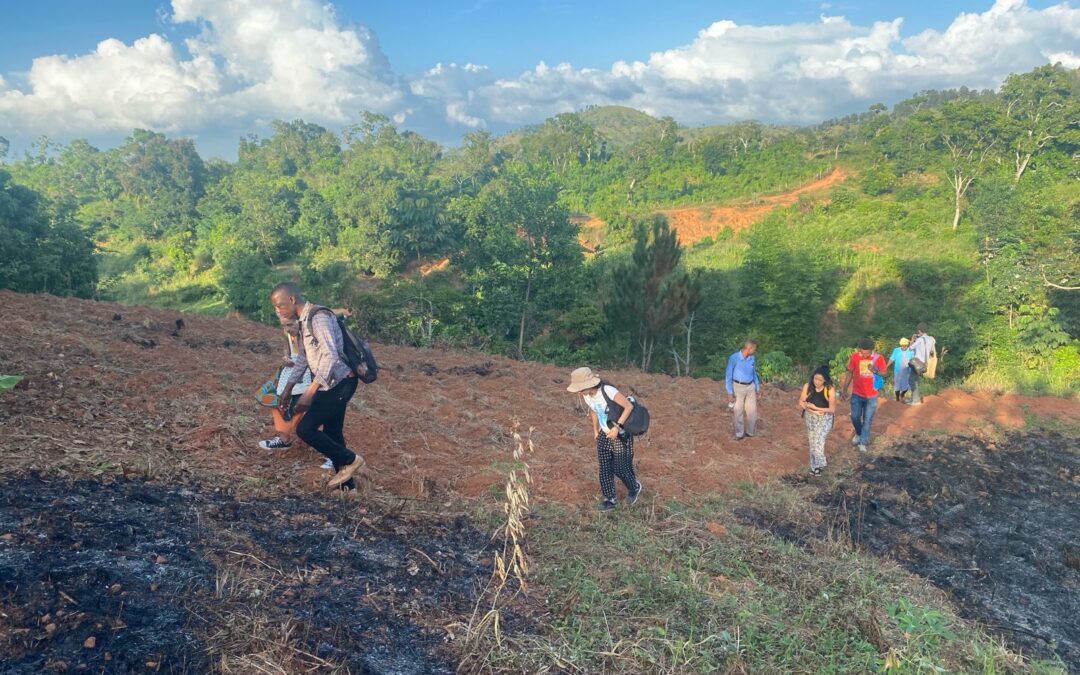
This area is densely populated by small-scale farmers and lies on active seismic faults, making any potential mining activity a matter of significant social and environmental complexity.
This is where the myth collapses in the face of reality. The honest answer is that no one knows with certainty the size of Haiti’s reserves. The country does not have an updated inventory.
During the 1970s and 1980s, studies suggested significant potential for gold and copper. Yet more than three decades without systematic exploration have left Haiti in a situation of informational blindness. What exists today are not proven reserves—as in Chile or the Dominican Republic—but rather “inferred resources” or simply exploration concessions previously granted to foreign companies, such as the U.S.-based Newmont. These companies carried out preliminary exploration but did not proceed to extraction due to social instability and community opposition.
In fact, between 2006 and 2013 more than 50 exploration permits were granted without proper environmental impact assessments. This led to conflicts involving the displacement of peasant farmers but did not result in actual mining production. Haiti therefore remains a country with potential wealth that has yet to be quantified, trapped in the speculative stage of mining development.
Natural Resources and Geopolitics
In today’s global landscape—shaped by the energy transition and the growing demand for strategic minerals such as rare earth elements used in batteries and advanced technologies—uncertainty about Haiti’s subsoil is not an innocent void. It has become a space of geopolitical and discursive contestation.
Professor Jean Eddy Saint Paul offers an important historical insight. As early as 1924, during the U.S. occupation, geologists such as Wendell P. Woodring conducted extensive studies of Haiti’s subsoil and published detailed findings in Geology of the Republic of Haiti. “The best experts in the United States have studied the soil and subsoil,” Saint Paul explains. “According to the information in that book, it is a very important country from a strategic perspective, because it has lithium, natural resources, minerals, and rare earth elements.”
According to Saint Paul, the paradox is that while the Dominican Republic has elites capable of negotiating the management of their resources, in Haiti “those in power do not have the capacity to negotiate with the United States what is actually beneficial for Haitian society.”
The Risk of the “Resource Curse”
There is also a narrative interested in portraying Haiti as a “failed state” in order to justify foreign intervention under the pretext of stability. This is not a new pattern. During the 1915 occupation, the United States took control of the National Bank and appropriated land. Today, international financial institutions and foreign powers promote mining as an economic solution, despite strong opposition from local communities who see the industry as a threat of land dispossession.
For the Haitian sociologist, any future exploitation of these resources would require a profound political transformation: “To exploit or grant concessions to foreign companies, we need nationalist or patriotic leaders both in Congress and in the Presidency—people who defend the interests of the Haitian people and who do not see natural resources as an end in themselves, but as a means to contribute to the well-being of the population.”
A Double-Edged Narrative
The myth of Haiti’s natural wealth therefore looms like a sword of Damocles. On one hand, it fuels hopes for miraculous economic development. On the other, it legitimizes attempts at external interference, environmental damage, land grabbing, and resource exploitation without local benefit.
In a world marked by active conflicts over oil, lithium, copper, and rare earth minerals, Haiti faces the risk that its vulnerability will be exploited. Its resources—whose real magnitude remains unknown—could become spoils for external powers, repeating the tragedy seen in many countries of the Global South where the resource curse has perpetuated instability instead of prosperity.
*This article is the second installment of the “Series: Mining in Haiti — context, risks and debates”, built within the framework of the Territory Defense Program of the Itinerant University of Resistance in Haiti.
References:
Diario Libre. Haitianos se preguntan si tienen tierras raras tras el hallazgo en Pedernales. Ver: https://www.diariolibre.com/mundo/haiti/2025/02/18/en-haiti-se-pregunta-si-tiene-tierras-raras/3002520
López Soto, Ximena Damaris. El concepto de “Estado fallido” como estrategia para la explotación en Haití (CLACSO). Ver: https://conferenciaclacso.org/programa/resumen_ponencia.php?&ponencia=Conf-1-1439-35442&eje=13
Somos Pueblo. Tras el hallazgo en Pedernales, Haití se pregunta si también tiene tierras raras. Ver: https://somospueblo.com/tras-el-hallazgo-en-pedernales-haiti-se-pregunta-si-tambien-tiene-tierras-raras/
Author’s interview with Professor Jean Eddy, Haitian sociologist (unpublished).