
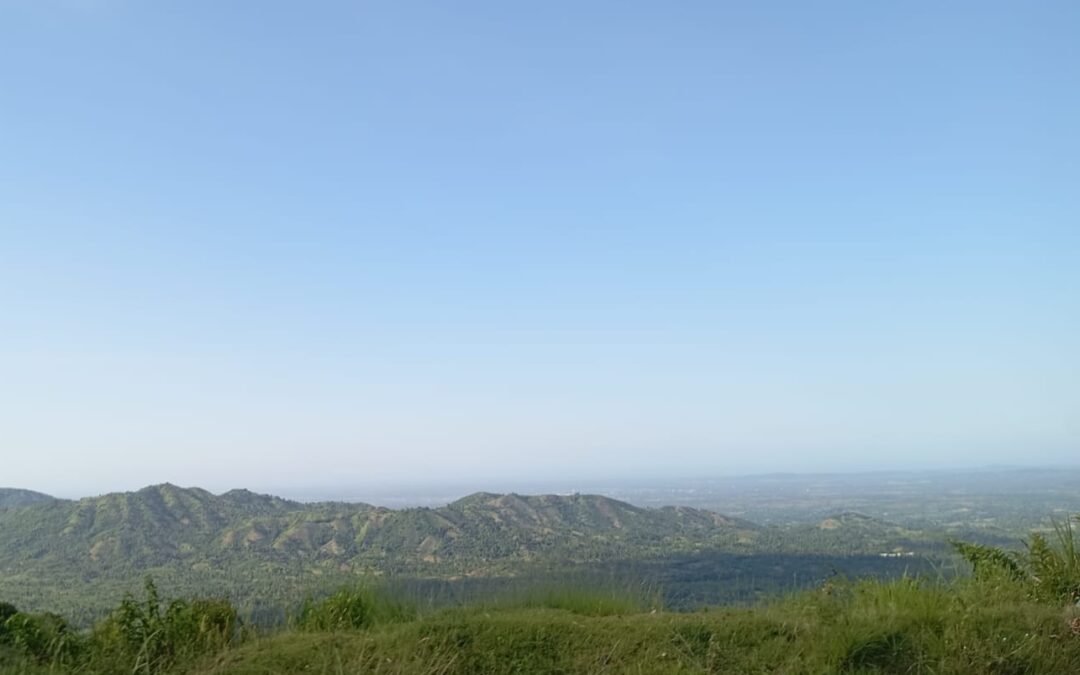

Fohlen, C. (s. f.). A Lakwew, dans le nord du pays, l’orpailleuse Pierre-Silia Bastien extrait des sacs de glaise. Elle espère trouver de l’or [Fotografía]. https://www.parismatch.com/Actu/International/Pour-quelques-pepites-d-or-Haiti-711156
By Paula Companioni
Translated by Eduardo Aguilar
External analyses and mining industry reports[1], conducted around 2014 and supported by prospecting in northern Haiti, have estimated a mining potential—particularly in gold, copper, and marble—of approximately 20 billion dollars. These estimates have fueled international interest.
To understand why Haiti’s subsoil wealth has not translated into development, it is necessary not only to examine present social conditions, but also to dig into a history of extractive colonialism, exploited concessions, and a resource curse that predates even the nation’s independence.
From Colonial Extraction to Structural Absence
Contrary to the popular image of massive mining colonies, the island of Hispaniola, during the 15th and 16th centuries, was not a major extractive center in the modern industrial sense. Although Spanish colonizers tirelessly sought gold, mining in what is now Haiti was a fleeting phenomenon. The most accessible alluvial deposits were quickly exhausted.
By the early 17th century, the gold rush had given way to sugar: plantation agriculture completely displaced mining as the core of the colonial economy.
Although there were sporadic mentions of hematite, chalcopyrite, and copper near Gonaïves during the French colonial period, the Crown consistently prioritized monoculture—sugarcane and coffee—over mineral extraction.
This early abandonment set a crucial precedent: unlike its Andean neighbors or Mexico, the insular Caribbean—and Haiti in particular—never developed a mining tradition or a geological bureaucracy during its formative colonial period. When Haiti became the world’s first Black republic in 1804, it inherited not only an oppressive external debt to France, but also a complete absence of systematic geological exploration.
It was not until the 20th century that a serious attempt was made to map Haiti’s subsoil. Ironically, this occurred during the U.S. Occupation (1915–1934).As noted in previous articles on the subject[2], the government in Washington sent the United States Geological Survey (USGS), led by W. Woodring, who in 1924 published The Geology of the Republic of Haiti. For the first time, Haiti gained certainty about the minerals it possessed. However, this knowledge did not benefit Haitians, but rather the foreign corporations that would arrive decades later.
The Duvalier Era: Extraction Without Development
The only truly industrial chapter of Haitian mining took place between 1957 and 1982, under the Duvalier dictatorships. The Reynolds Mining Corporation operated a bauxite mine in the Miragoâne region. During that quarter century, Haiti exported 13.3 million tons of the mineral to a refinery in Corpus Christi, Texas[3]. At its peak, this bauxite accounted for nearly one-fifth of Reynolds’ total supply.
For the Haitian government, this meant passive fiscal income; for the company, a highly profitable business; for peasant communities, the forced displacement of 150,000 hectares. The scholar Guy Pierre describes this period as one of “lightning capital accumulation and economic frustration,” showing how royalties dissolved into state coffers without generating local development.
Why Mining Never Took Off
After reviewing this background, the question of why the industry never took off remains open. From the perspective of economists and major investors, three structural factors stand out.
First, Haiti suffers less from a classic resource curse than from a curse of scarcity: deposits are often small, low-grade, or difficult to access.
Second, mining requires energy and infrastructure that the country lacks. High electricity costs, unstable supply, and weak transport systems make operations prohibitively expensive.
Third, Haiti is perceived as a “total risk” in the global market due to political instability, weak institutions, and lack of legal certainty.
A False Promise
This raises an essential question: even if these constraints did not exist, would the Haitian people benefit from a mining-based economy? The brief history of mining in Haiti is not one of a missed opportunity, but of an opportunity that never existed on favorable terms for the country. That 20-billion-dollar “treasure” is largely a geological and logistical mirage.
Until Haiti resolves its crises of governance, security, and energy, its mountains will remain silent witnesses to buried wealth. As in the 18th century, the country remains more profitable for what it could produce on its surface—if stability existed—than for what lies hidden beneath it. Mining did not save Haiti in the past and is unlikely to transform its present.
This article is the third installment of the series “Mining in Haiti — context, risks, and debates,” developed within the framework of the Territory Defense and Resistance Program of the Itinerant University of Resistance in Haiti.
[1] You can find more information at the following links: https://en.ayitikanpemin.org/resources-list/blog-post-title-two-rxsej-5bekp-g9lc8-hewhz and https://mepyd.gob.do/wp-content/uploads/drive/UEPESC/Informes/mineria-y-gestion-aguas-internacionales%20(1).compressed.pdf
[2] Natural Resources in Haiti: Between the Myth of Hidden Wealth and an Unexplored Reality, available at: https://www.nodal.am/2026/03/recursos-naturales-en-haiti-entre-el-mito-de-la-riqueza-oculta-y-una-realidad-sin-explorar-por-paula-companioni/
[3] Haiti’s Natural Resources: From Crisis to Opportunity?, available at: https://www-forbes-com.translate.goog/sites/saleemali/2024/03/09/haitis-natural-resources-from-crisis-to-opportunity/?_x_tr_sl=en&_x_tr_tl=es&_x_tr_hl=es&_x_tr_pto=tc&_x_tr_hist=true